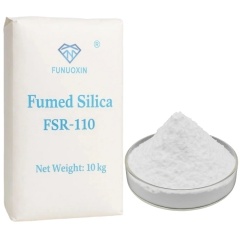
FSR-110 is a high-purity, hydrophobic fumed silica rheology control additive with a specific surface area of approximately 110 m²/g. Surface-treated with dimethyldichlorosilane (DDS), it is designed for use in non-polar and moisture-sensitive systems, where it provides reliable viscosity control, excellent dispersibility, and effective anti-settling and anti-sag performance.
Its moderate surface area combined with hydrophobic surface chemistry allows for easy incorporation, controlled structure build-up, improved water resistance, and enhanced formulation stability in solvent-borne and high-solids systems.
| Properties | Unit | FSR-110 |
| SiO2 content (dry basis) | wt.% | ≥ 99.8 |
| Loss on drying | wt.% | ≤ 0.5 |
| pH (4% suspension) | - | 3.6 – 5.5 |
| Specific surface area (BET) | m²/g | 90 – 130 |
| Tamped density | g/l | Approx. 50 |
| Surface treatment | - | Hydrophobic (DDS-treated) |
FSR-110 is particularly well suited for:
General industrial coatings requiring hydrophobic rheology control and good dispersion
Metal and corrosion-protective coatings where moisture resistance and storage stability are critical
Automotive OEM and refinish coatings for sag control and anti-settling performance
Coil coatings requiring consistent viscosity and reduced pigment settling
Plastic coatings demanding good compatibility with non-polar binder systems
Adhesives and sealants for controlled thixotropy, bead stability, and anti-sag behavior
High-solids and solvent-borne formulations where water sensitivity must be minimized
Printing inks and specialty coatings requiring stable rheology and improved suspension stability
Powder flow and anti-caking applications to improve free-flow and reduce agglomeration